Every account, every property, every receipt.
One link for your accountant at tax time.
Statements from your banks, ASX shares and Vanguard funds, super, investment properties and their loans — kept in one place all year, and turned into a tax pack your accountant opens with a single link. Investments back in India? Those too.
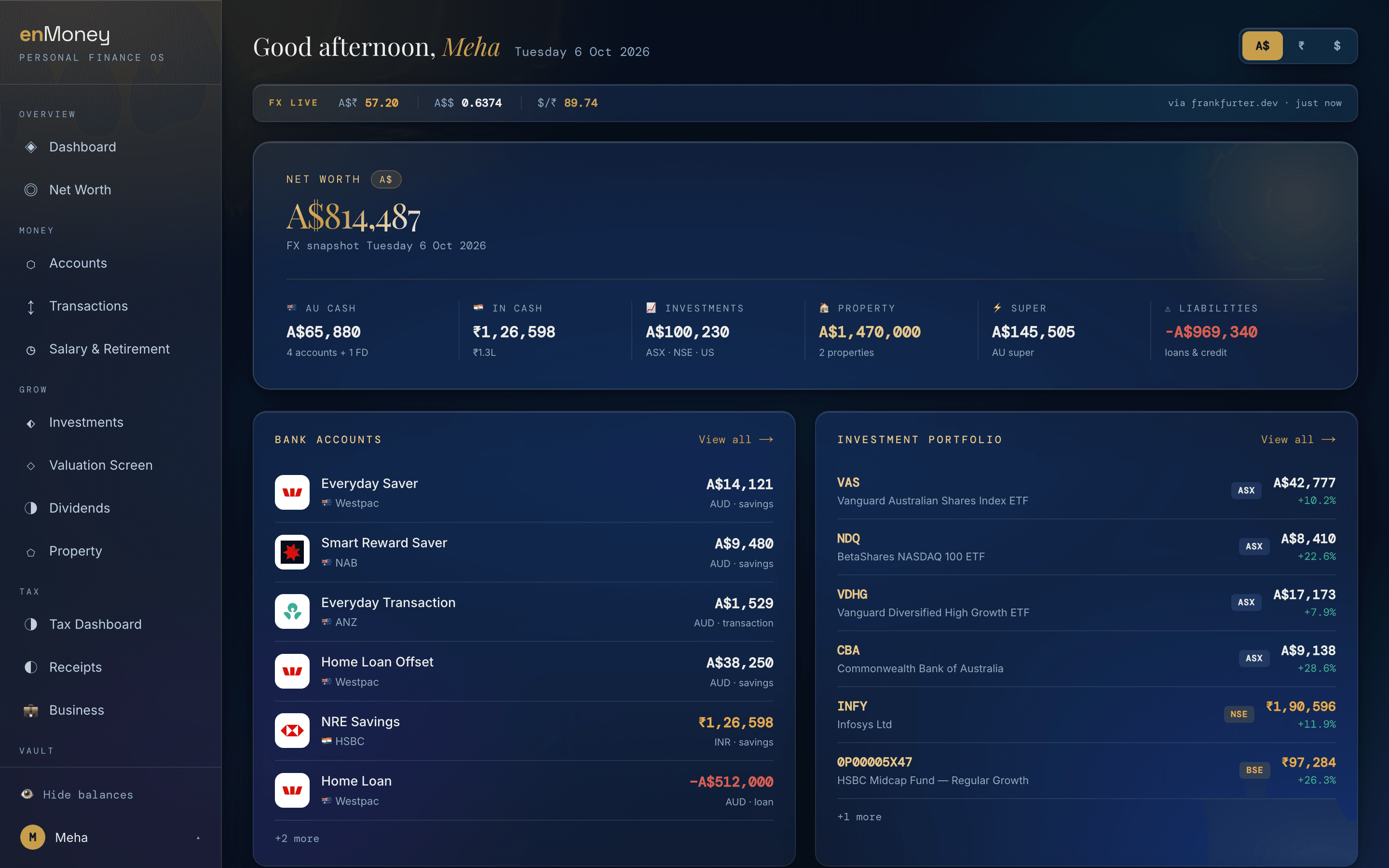
The actual dashboard, shown with sample balances — every figure on it is invented, and adds up.
Tax time shouldn’t start with a shoebox.
Statements from four banks, receipts scattered through an inbox, super on another website, a rental’s agent statements in a folder, and a spreadsheet to add it all up — rebuilt from scratch every July. Then your accountant asks what the property cost to hold, what the loan interest came to, and which of you owns what share, and every answer lives somewhere different.
The screens, with the numbers left in.
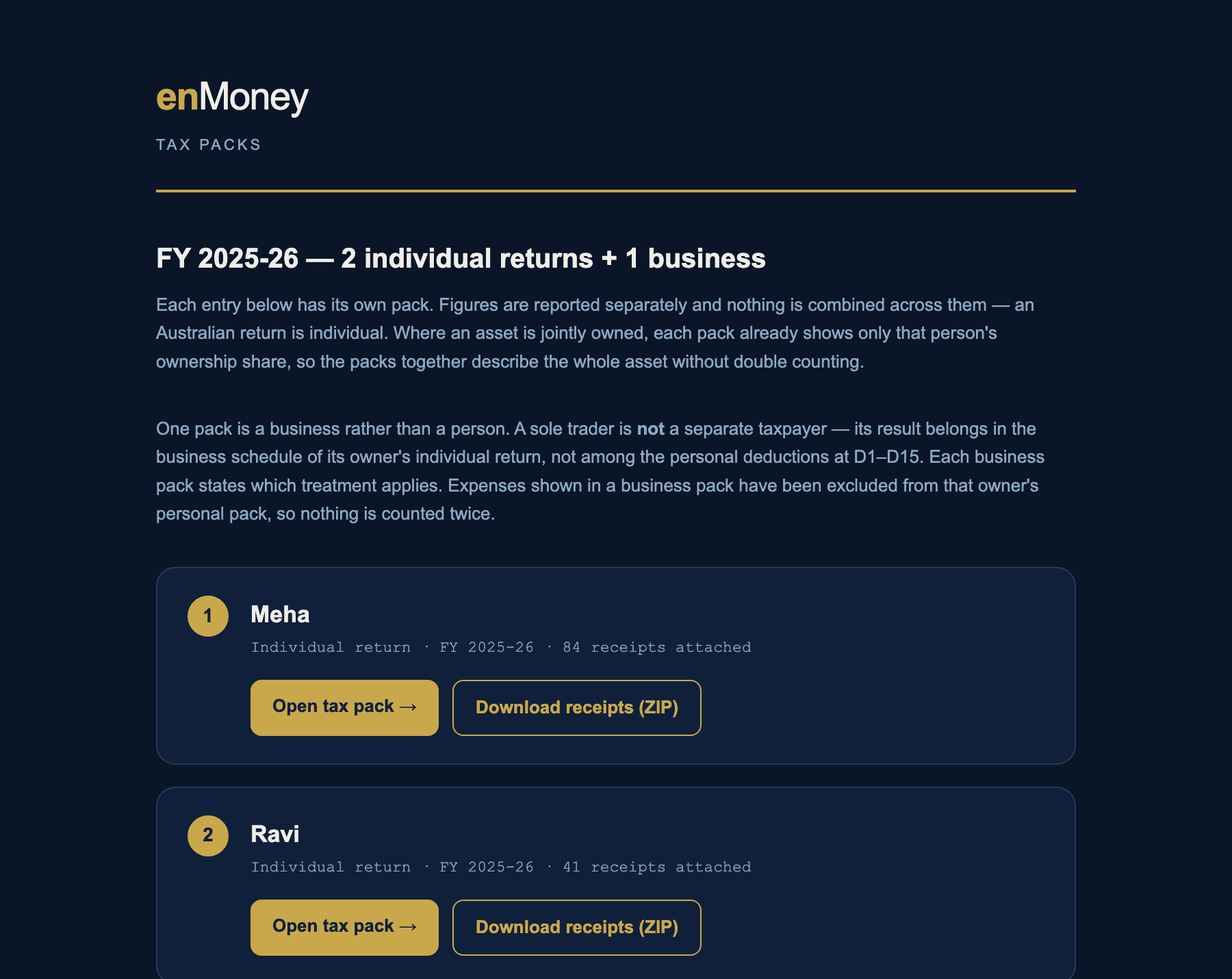
One link for the accountant.
Each person's pack and their receipts behind a single expiring link — rental income and costs per property, loan interest from the statements, deductions with the receipt attached. Jointly owned assets are already split to each owner's share, so the packs describe the household without counting anything twice.
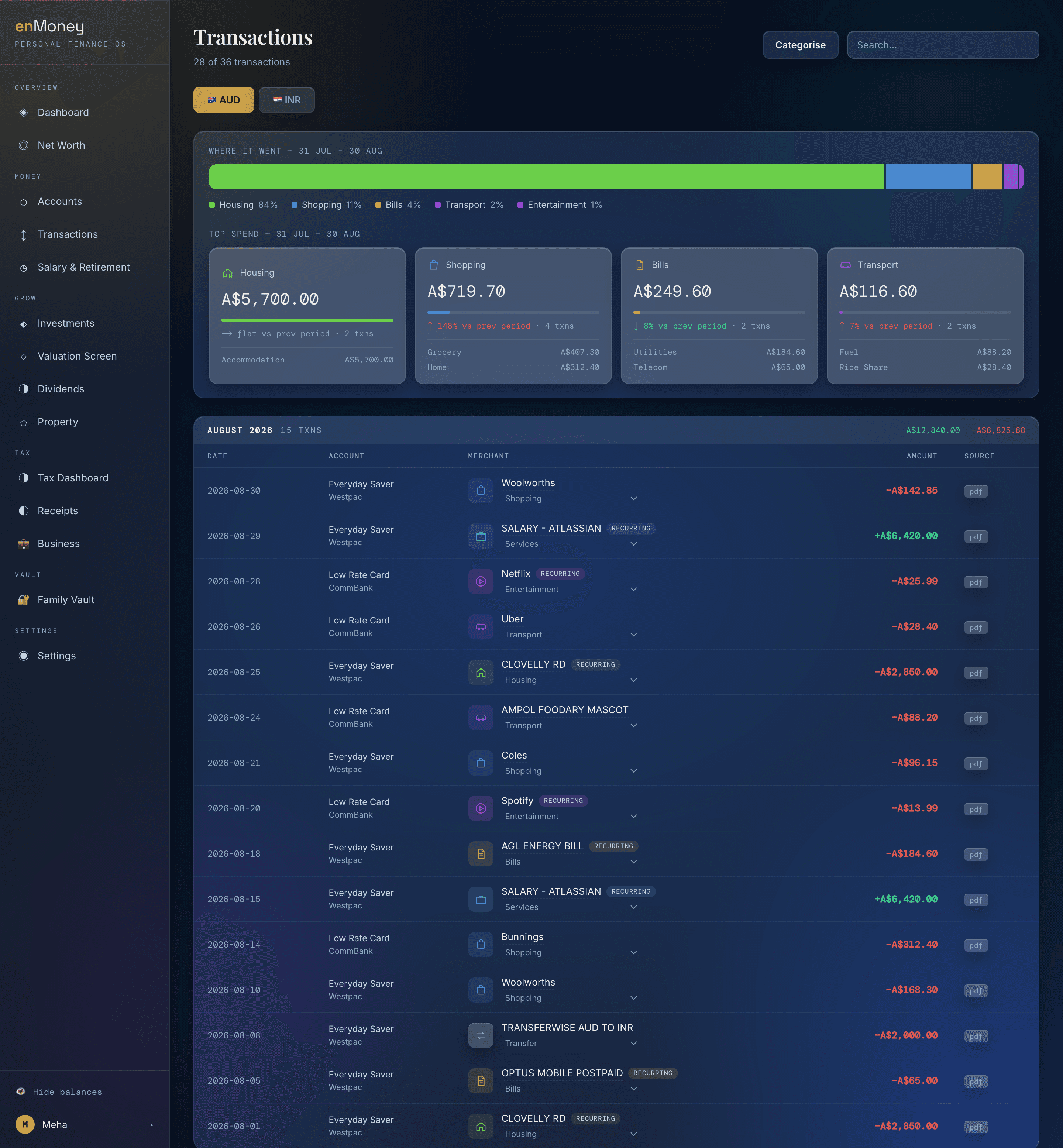
Statements in. Categories out.
Import a PDF statement and “WOOLWORTHS 1234 BONDI JUNCTION” becomes Woolworths, filed under Shopping, with the subscriptions flagged as recurring. Spending is compared against the equal window a month back, so the comparison is honest rather than flattering.
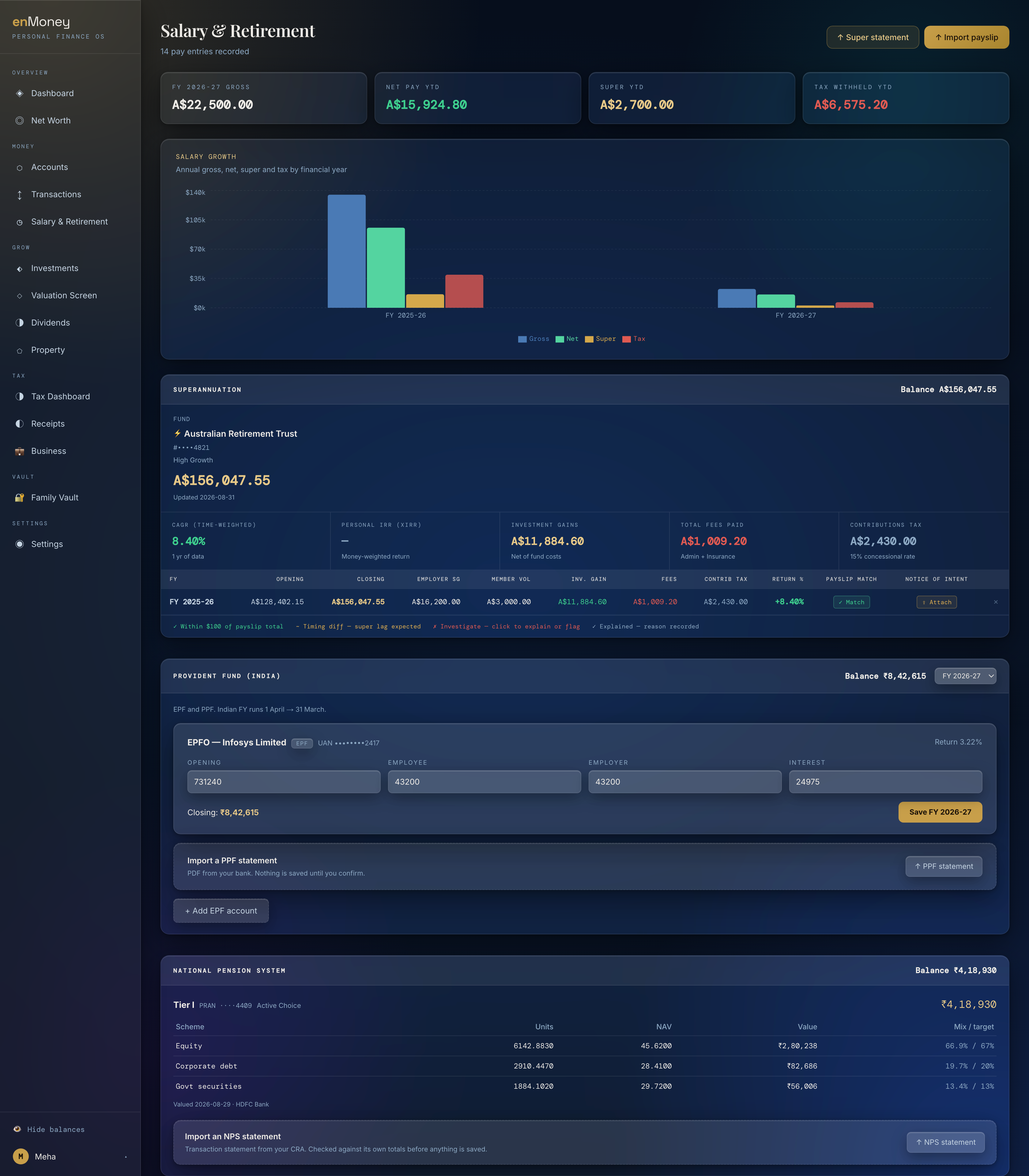
Super, reconciled against your payslips.
Your super statement checked line by line against what your payslips say was paid in, so a missed contribution shows up in weeks rather than at retirement. If part of your working life was in India, EPF and NPS sit on the same page.
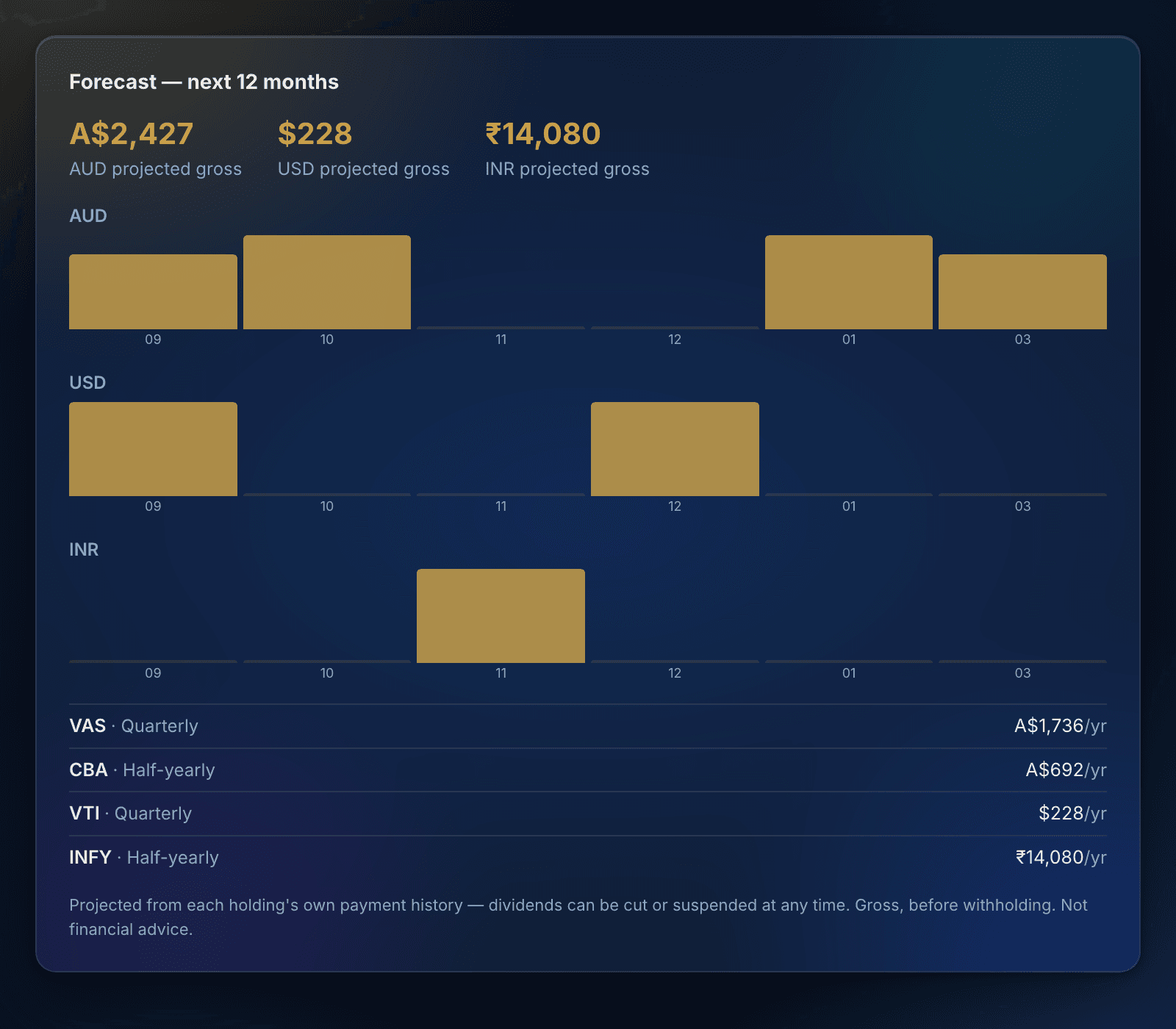
What the portfolio pays next year.
Projected from each holding's own payment history — its cadence and trailing twelve months — not a yield assumption. Anything paid overseas stays in the currency it arrives in, instead of being quietly converted.
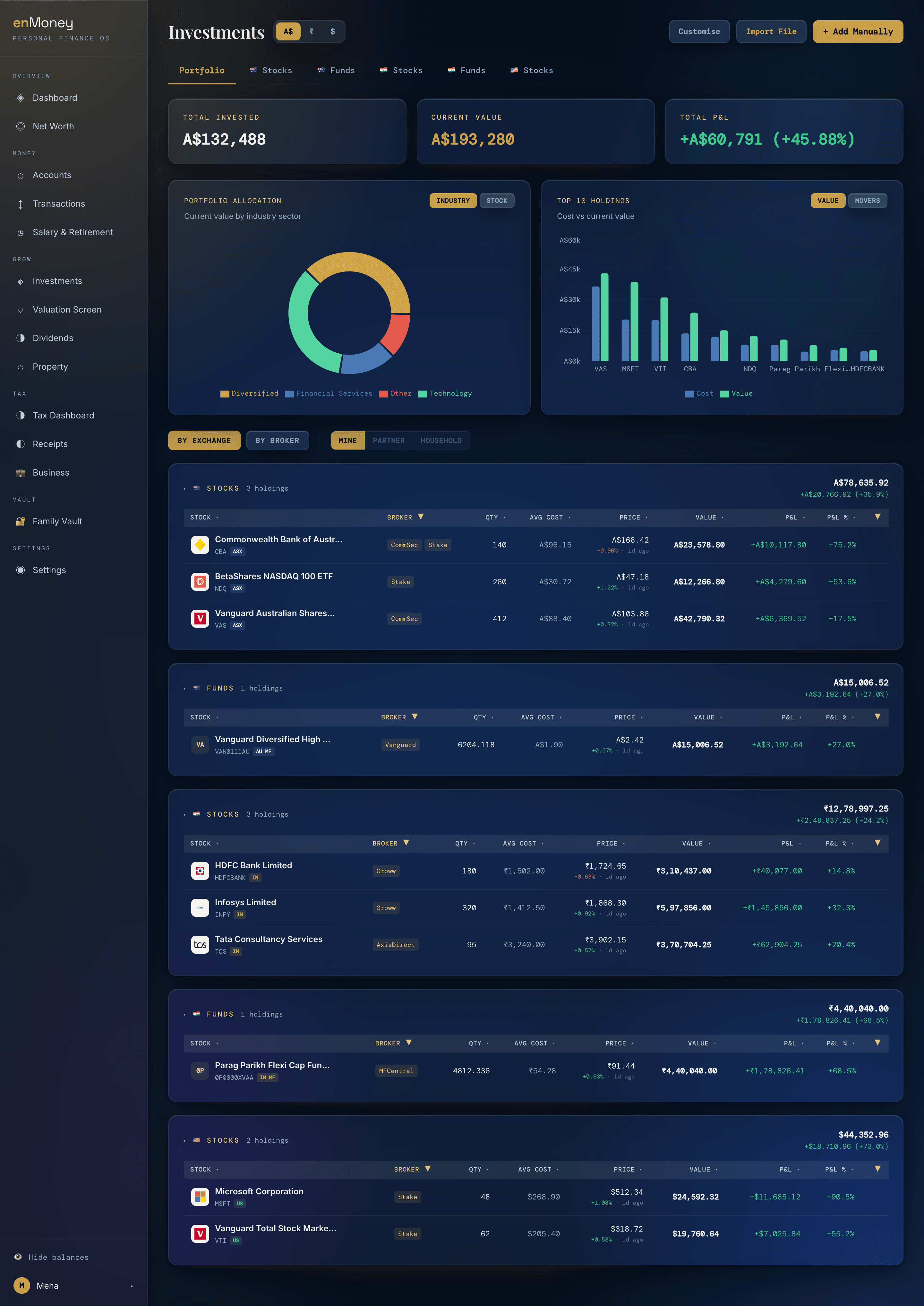
ASX and Vanguard — and anything held overseas.
ASX shares and ETFs, Vanguard funds priced by APIR code, and — if you have them — US shares and Indian shares and mutual funds, each group in its own currency. One portfolio, valued daily, with returns worked out properly rather than as a bare gain.
Built for the hand-over.
- ·One expiring link per financial year — your accountant never needs an account or a password
- ·Each person’s pack kept separate, the way the returns are
- ·Jointly owned property and shares already split to each owner’s share
- ·Rental income and costs per property, and loan interest taken from the statements
- ·Deductions with the receipt attached, not a total to take on trust
Are you an accountant? We are working with a small number of practices on what the pack should contain — write to support@enmoney.app.
Australia first. Overseas too.
Australia
- ·PDF statements from your banks, categorised automatically
- ·ASX shares and ETFs, Vanguard funds priced by APIR code
- ·Super statements reconciled against your payslips
- ·Investment properties: rent, costs and loan interest
- ·Franking credits and dividend history
- ·CGT with the 12-month discount
- ·A tax pack per person, per financial year
Got money back in India?
- ·Mutual funds priced daily from AMFI
- ·CAS statement import, SIPs detected automatically
- ·PPF with interest computed to the rupee
- ·NPS and EPF balances
- ·Capital gains under Indian rules, with an India tax pack
Across the board
- ·Net worth in Australian dollars, live FX for anything overseas
- ·US shares and ETFs priced too
- ·True returns with XIRR, not just gain
- ·Property, loans and fixed deposits
- ·Goals that earmark money you already hold
- ·Households: one subscription covers you and your partner, and each shares only what they choose
Some of it works without an account.
The same engines the app runs on your real data, as calculators anyone can use — no sign-up, nothing stored.
Your financial data belongs to you.
Your data is stored in Sydney, Australia. enMoney doesn’t sell it, share it with advertisers, or use it for anything other than running the app. There is no page-view or click analytics, and no tracking cookies. Uploaded documents — receipts, payslips, statements — sit in private storage, reachable only through short-lived links tied to your account, and are sent to Google Gemini to be read for dates, amounts and merchants. The privacy policy spells out exactly what goes where.
Broker connections read holdings and trades only. enMoney never places an order and never moves money — no part of it can. Credentials are encrypted with a key held outside the database, so a database dump does not yield them. How your data is kept.
Next July, already done.
enMoney is invite-only while it’s early. Leave your email and we’ll get in touch when a spot opens — and tell us what you need it to do. Early requests are what set the order things get built in.